Serious diamond enthusiasts rely on the 4Cs. However, many buyers seek a deeper understanding of diamond types. What exactly is a diamond type, and why does it matter?
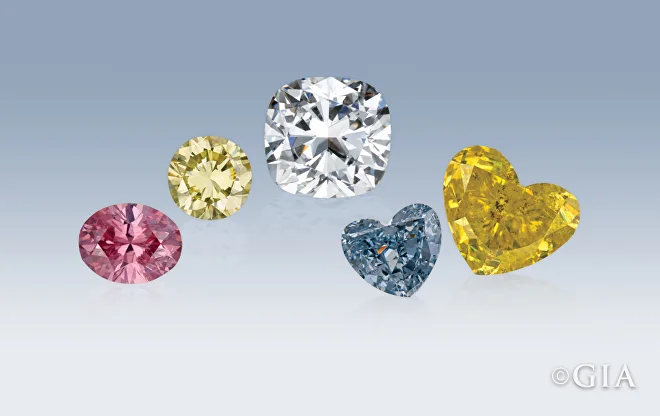
From left to right: 0.47 ct Fancy Pink Diamond (Type Ia); 0.38 ct Yellow "Cape" Diamond (Type Ia); 1.04 ct Colorless Diamond (Type IIa); 0.56 ct Blue Diamond (Type IIb); 1.01 ct "Canary" Yellow Diamond (Type Ib).
Classifying diamonds into types is a straightforward method of categorizing them based on their chemical composition and physical properties. This is crucial because it provides the foundation for identifying natural, lab-grown, and treated diamonds. While diamonds are composed almost entirely of pure carbon, many natural stones contain trace impurities — such as nitrogen or boron — incorporated during their formation deep within the Earth.
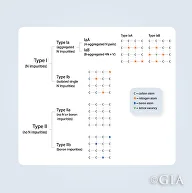
This diagram illustrates how nitrogen and boron atoms can replace carbon atoms within the diamond's crystal lattice.
In other diamonds, trace elements are introduced through artificial treatment or laboratory growth processes. Diamonds can also exhibit irregularities within their carbon lattice structure, which scientists refer to as lattice defects or optical defects. These impurities and structural nuances are vital because they govern how a diamond displays color and reacts to ultraviolet light. The presence or absence of these lattice defects, their concentration, and their arrangement within the crystal structure can profoundly influence the diamond's overall appearance.
In the 1930s, scientists first introduced two categories to describe a diamond's chemical purity and atomic structure: Type I and Type II. Today, these categories have evolved into refined subcategories: Type Ia, Type Ib, Type IIa, and Type IIb.
Type Ia:
Diamonds of this type contain clustered nitrogen atoms. Approximately 95% of all natural diamonds belong to Type Ia. Their color typically ranges from near-colorless to light yellow. They are often historically referred to as "Cape" diamonds, named after South Africa's Cape Province, where they were originally discovered.
Type Ib:
These diamonds also contain nitrogen, but as isolated single atoms rather than clusters. They frequently exhibit vibrant, saturated yellow hues. Natural Type Ib diamonds are exceptionally rare and are often referred to in the trade as "Canary" diamonds.
Type IIa::
Type IIa diamonds are characterized by the absence of measurable nitrogen or boron impurities. They are usually colorless, though they can occasionally display grey, light brown, light yellow, or soft pink tones. Of all diamonds, Type IIa stones are chemically the purest.
Type IIb:
These diamonds are famous for their electrical conductivity. The presence of boron imparts a captivating blue or greyish hue to most Type IIb diamonds.
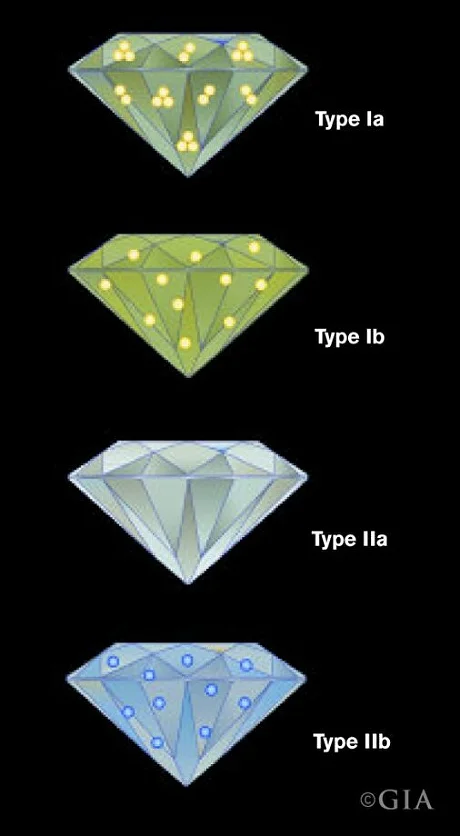
Зверху донизу: тип Ia, тип Ib, тип IIa, тип IIb.
GIA conducts diamond type analysis as a specialized standalone service; the results are provided as an additional analytical finding and are not included on standard GIA grading reports. GIA utilizes Fourier Transform Infrared Spectroscopy (FTIR) to measure the diamond's electromagnetic radiation absorption patterns.
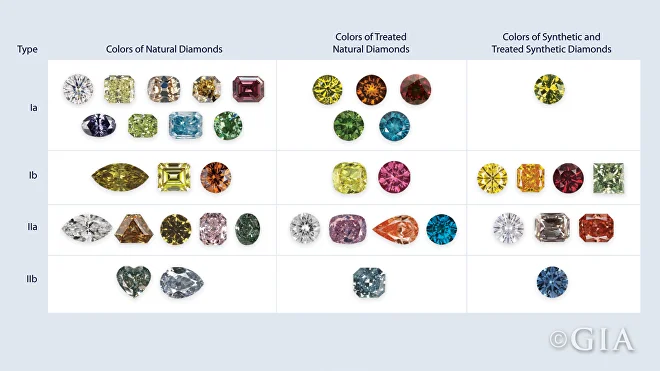
Top to bottom: Diamond types.
Left: Natural diamond colors, treated natural diamond colors, lab-grown and treated lab-grown diamond colors.
For instance, a Type IIa diamond can be natural, laboratory-grown, or color-enhanced through treatment.